Shadow Report 2026: Civil Society Organizations Assess Ukraine’s Progress in the Fundamentals Cluster
A coalition of civil society organizations, coordinated by the Agency for
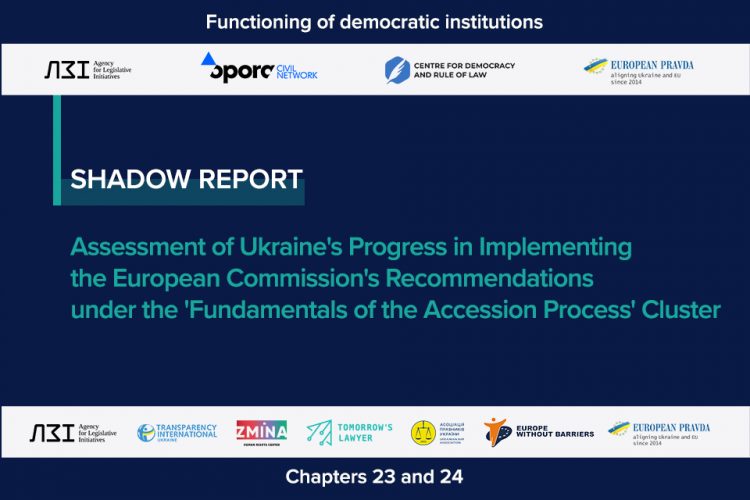
Legislative Initiatives, has released its annual Shadow Report—an independent assessment of how Ukraine is fulfilling its European integration commitments within the “Fundamentals of the Accession Process” cluster.
Tomorrow`s Lawyer prepared the section titled “Reform of the Bar.” It analyzes the role of the Bar in strategic documents, the work of bar self-governance bodies, access to the profession, professional development, disciplinary liability, and the finances of the Bar. It also examines judicial control of decisions by the Bar Self-Governance Bodies, the rights and guarantees of attorneys, and the Council of Europe Convention on the Protection of the Profession of Attorney.
The text of the report covering Chapters 23 and 24 is available at this link. The section on the Bar is on pages 211–252
Summary version of the report is available at this link. The section on the Bar is on pages 85–90
 In 2026, Ukraine opened negotiations on four of the six clusters at once. At the same time, the “Fundamentals of the Accession Process” cluster remains the cornerstone of the entire negotiation process: it is the first to open and the last to close, and progress in the rule of law, the functioning of democratic institutions, and the fight against corruption influences progress in other areas.
The Shadow Report examines this process from the perspective of civil society. A coalition of civil society organizations, coordinated by ALI, assessed what still needs to be done, where gaps remain, and what further steps are necessary to fulfill Ukraine’s European integration commitments.
This is the third time ALI and its partners have prepared the Shadow Report. This year, independent monitoring has expanded significantly. In addition to Chapters 23, “Justice and Fundamental Rights,” and 24, “Justice, Freedom, and Security,” experts conducted a comprehensive analysis for the first time of another component of the “Foundations of the Accession Process” cluster—“Functioning of Democratic Institutions.” Taken together, this provides a broader picture: not only the status of individual reforms, but also the functioning of the institutions upon which their implementation depends.
The number of coalition members has also grown. As of 2026, it includes nine civil society organizations: The Agency for Legislative Initiatives, Transparency International Ukraine, ZMINA Human Rights Center, “Tomorrow`s Lawyer,” the Ukrainian Bar Association, “Europe Without Barriers,” the OPORA Civic Network, the Center for Democracy and the Rule of Law, and “European Pravda” (information support). This is a community of experts who systematically monitor and analyze changes in the processes and work of state institutions as Ukraine moves toward the EU, identify problems, and formulate specific recommendations for meaningful progress.
The report consists of two parts and covers the areas of the rule of law (courts, the prosecutor’s office, the Bar, and legal education), the fight against corruption and organized crime, the protection of fundamental human rights and freedoms, visa policy, migration, issues of European integration, the work of the Verkhovna Rada of Ukraine, the Government, multilevel governance, elections, civil society, and more.
The first part is devoted to the area of “Functioning of Democratic Institutions.” The second part contains an assessment of progress under Chapters 23, “Justice and Fundamental Rights,” and 24, “Justice, Freedom, and Security.” The monitoring under Chapters 23 and 24 covers the period from September 2025 to August 2026. In the area of “Functioning of Democratic Institutions,” experts also conducted an additional analysis of the state of affairs over a broader time frame (up to September 2025).
This shadow report was prepared by a coalition of civil society organizations coordinated by the Agency for Legislative Initiatives, comprising the ALI, Transparency International Ukraine, the ZMINA Human Rights Center, Tomorrow`s Lawyer, Ukrainian Bar Association, “Europe Without Barriers,” the OPORA Civil Network, the Center for Democracy and the Rule of Law, and with informational support from “European Truth.”
Its content is the sole responsibility of the authors and does not necessarily reflect the position of the European Union.