
Why the reform of the bar has become part of Ukraine’s European integration and what the EU requires to be changed
Why the reform of the bar has become part of Ukraine’s European integration and what the EU requires to be changed
Author: Daria Pysarenko,
Executive Director of the CSO “Tomorrow`s Lawyer”,
for “European Pravda”
When it comes to “European” reforms in the justice system, courts are usually mentioned. Much less often, the reform of the prosecutor’s office is mentioned. But there is a third element of this agenda that is often overlooked, and for no good reason. This is because its reform is a mandatory and inevitable component of the European integration agenda.
We are talking about the bar system. It is an indispensable element of the justice system and, at the same time, the only one that still operates under the old rules of 2012 and has not yet undergone reform. Therefore, the EU is now recommending that it be reformed.
Without modernizing the Bar, one of the key components of the justice system, it is impossible to complete judicial reform as a whole. However, the European Commission in its reports has noted for the third year in a row the lack of progress in Bar reform in Ukraine.
But 2026 could be decisive.
For the first time, the EU has included the requirement for this reform in the list of priorities for Ukraine – those which the EU will monitor closely and evaluate their implementation. Also for the first time in many years, concrete state instruments have emerged in Ukraine that should produce results regarding this reform.
How this reform became an EU requirement
In its latest report on enlargement, the European Commission expanded the list of priority tasks facing Ukraine in the field of justice.
For the first time since Ukraine gained candidate status, this short list included a requirement that Ukraine should“advance the reforms of the Bar” by 2026. However, this point did not become a priority out of the blue. The fact is that previous EC reports (for 2023 and 2024) contained almost identical comments, and the European Commission could only conclude that the reform of the bar was not progressing.
The new status of this requirement in the European report should draw Kyiv’s attention to the problem.
The problems of the bar are also described in the Shadow Reports for 2024 and 2025 (which were prepared with the involvement of independent experts from the CSO “Tomorrow`s Lawyer”) . These documents were also available to the European Commission, so this is not news to Brussels. However, 2025 became a turning point.
But at the same time as the EU’s attention grew, changes also appeared in Ukrainian documents.
Thus, the section on the Bar was included in the Roadmap for Reforms in the Field of the Rule of Law, one of the key benchmarks in Ukraine’s movement towards the EU. This roadmap has been agreed with the EU. The government approved it in May 2025.
The NACP also included the Bar in the draft Anti-Corruption Strategy for 2026–2030.
In addition, while preparing the Shadow Report, we learned from interviews with representatives of the Office of the President that the Bar is also planned to be integrated into the new Strategy for the Development of the Justice System for the coming years, with quite ambitious reform requirements.
This means that the issue is no longer an internal professional discussion but has become part of the state’s official European integration commitments, enshrined in strategic documents.
And the EU’s attention is real: the author felt this in December 2025 during the presentation of the Shadow Report in Brussels, where European officials were interested in the reasons for the delay in reforming the bar and whether the actions taken by the state and lawyers were sufficient.
The independence of the bar does not mean unaccountability
It is important to emphasize that this reform will differ significantly in its approach from other reforms in the field of justice.
The bar is an independent institution. However, independence does not mean uncontrolled. The bar performs the constitutional function of ensuring the right to defense, delegated to it by the state, and therefore, the state must determine the legislative framework for its existence.
Back in 2012, the law “On the Bar and the Practice of Law” was introduced. It is worth recalling that at that time, laws so important to justice were drafted by Andriy Portnov.
The implementation of the law revealed systemic gaps and shortcomings that led to a deep crisis of confidence in the bar as a public institution. And since 2022, the bar has ceased to perform one of its constitutional functions in the justice system: it does not delegate its representatives to the High Council of Justice (HCJ) and the Qualification and Disciplinary Commission of Prosecutors (QDC), which has caused a personnel crisis in these bodies.
That is why Ukraine needs to develop a new policy and rules for the functioning of the Bar. Without interfering with the professional independence of lawyers, but ensuring the quality, accountability of the institution, and restoring public trust in it.
Here, too, we have a fresh practical step.
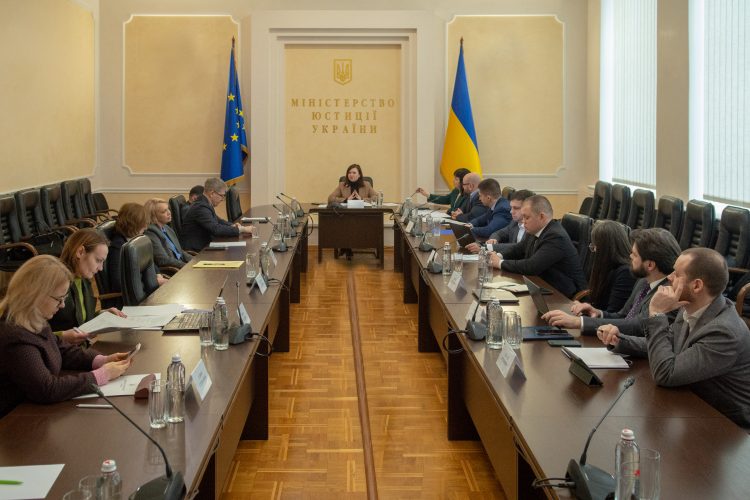
On January 12, 2026, a government working group was created to improve legislation on the bar, co-chaired by Deputy Minister of Justice for European Integration (currently acting minister) Lyudmila Sugak and Chairman of the Parliamentary Committee on Legal Policy Denis Maslov.
The roadmap identifies the Ministry of Justice, the Verkhovna Rada, and the UNBA as the implementers of the reform. This is logical, since the Ministry of Justice develops policy, the Parliament passes laws, and the UNBA implements changes.
This division is fundamentally important. The government and Parliament have exclusive authority to develop new policies and establish updated rules in the field of advocacy, to which the state, I repeat, has delegated its function. Preserving the professional autonomy of lawyers, but setting standards of quality, transparency, and accountability to society.
More than 80% of the working group members are lawyers — both those who practice daily in courts and those who currently hold other positions but retain their professional experience and understanding of the realities of the legal profession. Among them are members of parliament, scholars from leading law faculties, experts from international projects, representatives of the UNBA and other stakeholders, including the Council of Europe and organizations that prepared the Shadow Reports.
It is important that the group includes representatives of the All-Ukrainian Bar Association and the Ukrainian Advocates’ Association, which, throughout their history, have voluntarily united more than 9,500 lawyers (attorneys) and even more legal professionals. This composition of the group ensures both high-quality representation of the legal profession and an alternative vision of reforms.
The group includes both supporters of profound changes and those who believe that no systemic reforms are needed at all. This diversity can be both a strength and a trap. There is a risk that the group will turn into a platform for months of discussions, where each proposal will be blocked by opponents from the opposite camp.
What exactly is the problem and what does the Anti-Corruption Strategy have to do with it?
The inclusion of the Bar in the draft Anti-Corruption Strategy for 2026–2030 deserves special attention.
For the first time, the Bar has been identified as a separate component of the Anti-Corruption Strategy, alongside the courts and the prosecutor’s office. This is in line with the European Union’s vision that reducing corruption risks should cover all components of the justice system, including the legal profession.
The provisions included in the draft anti-corruption strategy are consistent with the Roadmap and the EC’s recommendations in its annual enlargement reports for 2023–2025. In fact, this is about institutionalizing at the level of state anti-corruption policy those problems that the European Commission consistently identifies as obstacles to the proper functioning of bar self-government.
After approval by the government, the anti-corruption strategy must be submitted to parliament in the form of a law. Thus, all processes related to the reform of the bar will come together in the Verkhovna Rada. And it is in the Verkhovna Rada that it will be decided whether European integration commitments will be transformed into real institutional changes within the framework of the new legislation on the bar.
In general, the conclusions of all the documents mentioned (the Roadmap, the EC report, the anti-corruption strategy, etc.) converge on a common list of systemic problems facing the legal profession. In particular, the key challenges are:
– – lack of democratic procedures for forming self-governing bodies of the bar and imbalance of powers between central and regional bodies;
– lack of elections for self-governing bodies since 2022 (70,000 lawyers cannot elect representatives who would have their trust);
– staffing crises in the High Council of Justice and the QDCP due to the Ukrainian National Bar Association’s failure to perform its delegation functions;
– non-transparent and technologically outdated procedures for access to the profession with corruption risks;
– de facto monopolization of the system of professional development for lawyers, which negatively affects the quality of professional development;
– use of disciplinary mechanisms as a tool to pressure lawyers who publicly criticize the state of self-government;
– non-transparent management of the financial resources of the bar. Self-government bodies do not publish financial reports on the use of mandatory contributions from lawyers and other revenues.
The impact of the crisis in the bar on justice
The crisis in the bar has two dimensions – external and internal.
The external dimension manifests itself in the bar’s failure to perform its constitutional functions.
The internal dimension of the crisis is related to issues of the legitimacy of decisions, the organization of self-government, and the accountability of governing bodies to the lawyers themselves.
It should be recalled that in 2022, the term of office of the bar self-government bodies expired, but their regular elections were canceled by the Bar Council of Ukraine, citing martial law (although the law on the introduction of martial law does not contain such a prohibition, and similar bodies of judicial and prosecutorial self-government have already held their own elections twice during this period).
As a result, lawyers have a bar self-government body elected in 2012 and almost completely re-elected in 2017, which has remained unchanged for over 14 years, including the chair of the UNBA and the BCU, Lidiya Izovitova.
After all, it is difficult to remember another powerful institution in Ukraine that would be run by the same people as in 2012.
But elections won’t solve the problem. The entrenched system needs to be changed.
This is what the European Commission emphasizes in its 2025 report: first, the legislative rules for the formation of bar self-government bodies must be changed, and only then should elections be held.
The current model, with its quotas and multi-level delegation, effectively restricts competition and allows the current leadership to concentrate control and have only loyal participants in the Bar Congress, which will elect new leaders. That is why the expert recommendations provide for the introduction of modern voting tools, in particular an online format that corresponds to the scale of the profession, which has more than 70,000 lawyers.
Against this backdrop, the statement by the head of the UNBA and the BCU, Lidiya Izovitova, about the impossibility of introducing online voting due to “Electronic warfare jammers, problems with electricity and the internet” looks more like an institutional objection to change than a technical argument.
Reforming the electoral procedures for self-government will be a key task for the working group. After all, it is the election rules that determine the legitimacy of these bodies and, most importantly, should enable new leaders of the bar to come to power and implement changes.
What the current NAAU leadership proposes
During the preparation of the Shadow Report, we invited all central bodies of the bar self-government to be interviewed. Unlike the Office of the President, the Ministry of Justice, and the parliamentary committee, which agreed to be interviewed, the bar associations refused, in particular, by setting the condition of withdrawing the previous Shadow Report.
We subsequently wrote to the UNBA asking for their position on the recommendations set out in the European Commission’s enlargement reports regarding the bar. In its response, the UNBA stated that it had not received the EC reports for 2023-2024 and therefore had nothing to say.
In other words, the UNBA considered the fact that they had not “officially” received public documents published not only by EU institutions but also by the Ukrainian government to be a sufficient argument.
However, it seems that attitudes toward EU requirements are now changing.
In early 2026, the UNBA announced the opening of its office in Brussels, a step that was not available to other institutions of the justice system, in particular the judicial or prosecutorial self-government, which are also the focus of reforms. This step raised questions among the professional community about the sources of funding for such representation, its practical feasibility, and its purpose. Is this office necessary to protect the professional interests of lawyers, which was the purpose for which the UNBA was created in 2012? Or is its purpose to strengthen the position of the UNBA leadership in order to preserve the status quo?
It is worth recalling that reports on the use of lawyers’ contributions have not been published for five years, which remains one of the key demands of lawyers.
Be that as it may, right now there is a chance to change the least reformed part of the Ukrainian judicial system.
And European integration gives hope that these changes will be meaningful.
After all, the EU emphasizes the need to revise the 2012 law, which created the illusion of self-government but did not ensure either genuine responsibility or accountability to lawyers, and became an instrument of abuse. Moreover, the European Union should consider including the reform of the bar in the mechanisms for conditional financial support, as is already the case with other elements of the rule of law. So far, these are only recommendations — they can be imitated. When it is a condition for funding, there is a real incentive for change.
However, if the next elections for the leadership of the UNBA and the UBA are held under the old rules, this will mean the current model will be effectively entrenched for at least another term—five years. In this case, the reform of the bar will return to the European Commission’s reports as an example of a missed opportunity.